
Use AI on flows, not on tasks
Carl-Axel Dahlin · 2026-05-28
INSEAD has published a field experiment on AI and firm performance. The most interesting part wasn't the numbers — it was what they call Mapping Patterns.
The problem they're trying to solve is called the mapping problem: where does AI actually create value in an organisation? Their answer: stop mapping AI to individual tasks. Map it to flows.
Seven patterns
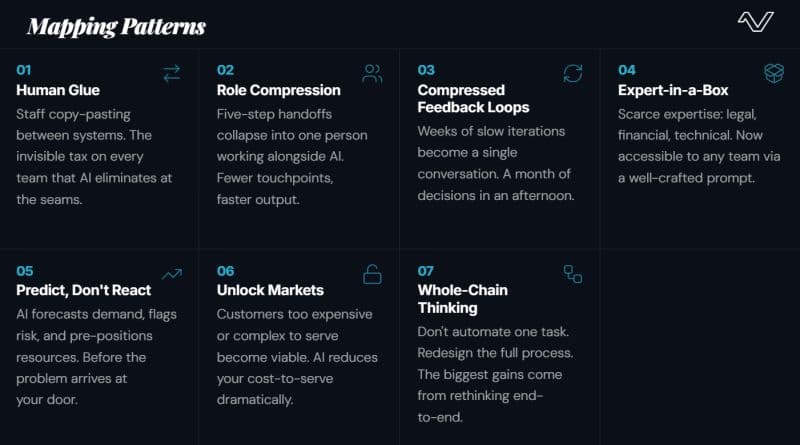
01 Human Glue — The staff who copy-paste between systems. The invisible tax on every team that lives in the seams between tools. AI eliminates it.
02 Role Compression — Five-step handoffs collapse into one person working alongside AI. Fewer touchpoints, faster output. Gamma.ai is a clear example: instead of a sequential chain of PM, design, engineering, and QA, AI is used to discover usage patterns, generate variants, and support evaluation. A PM drives most of it, plus the last mile with one engineer. Seven roles became two.
03 Compressed Feedback Loops — Weeks of slow iterations become a single conversation. A month of decisions in an afternoon.
04 Expert-in-a-Box — Scarce expertise in legal, financial, or technical domains becomes accessible to any team via a well-crafted prompt.
05 Predict, Don't React — AI forecasts demand, flags risk, and pre-positions resources. Before the problem arrives at your door.
06 Unlock Markets — Customers who were too expensive or complex to serve become viable. AI reduces your cost-to-serve dramatically.
07 Whole-Chain Thinking — Don't automate one task. Redesign the full process. The biggest gains come from thinking end-to-end.
The seventh pattern is the one that summarises all the others. Most AI implementations stall at the task level. The value sits in the chain.
Study: Mapping AI into Production: A Field Experiment on Firm Performance