
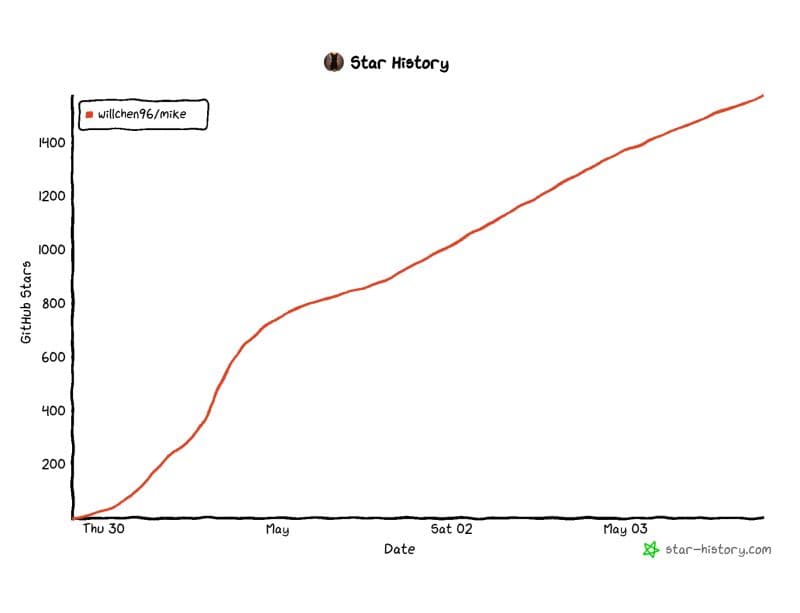
The open-source alternative to Harvey/Legora hit 1,000 GitHub stars in 48 hours
Carl-Axel Dahlin · 2026-05-28
Will, a former Latham & Watkins trainee, posted an open-source legal AI tool at mikeoss.com and went to sleep. When he woke up, the project had passed 1,000 GitHub stars. It took 48 hours.
What happened in the first few days
Three reactions stood out among the early users:
Cordell & Cordell, one of the largest family law firms in the US, had its CEO running the tool air-gapped on a private GPU cluster. Not a PoC. Not a demo. A CEO who chose to run it on his own servers to keep privileged material inside the perimeter.
An engineer at iManage — one of the leading document management systems for law firms — had wired in local models.
A CISO described it as "a watering hole for privileged material." The phrasing sounded like a warning. He meant it as a compliment.
Harvey and Legora did not comment.
What it actually is
It is not a Harvey alternative in the procurement sense. It is a provocation with working code.
Building is easy. Selling to law firms is hard. Security and trust are real things, not FUD. And getting access to case law databases from Thomson Reuters, Karnov, and similar providers costs money and requires contracts.
But the question of what happens when legal-hackers start improving and forking it is not rhetorical. Right now it is interesting for small firms and in-house legal teams that can manage their own infrastructure. It may also die without leaving much of a trace. Either way, the point has been made.
Why it matters now
Legal AI is currently a market built on opacity: opaque models, opaque pricing, opaque data agreements. The argument that "Harvey/Legora can do this, but you cannot see how" has worked because the alternative was nothing.
The alternative is now visible. It is not polished, it is not enterprise-approved, and it will not win an RFP at a Magic Circle firm next quarter. But it has a GitHub repo, it runs locally, and it put 1,000 stars on the board in 48 hours.
Helen Fan (Chief AI Officer, "Legal AI Value Stack") shared it with her network in Silicon Valley and Beijing. Jack Cosentino, CEO of Splitifi: "It's shockingly good. Open Source for law could go a long long way." Harrison Jordan, a Canadian regulated-industries lawyer: "PROTECT THIS MAN AT ALL COSTS."
Will's LinkedIn profile is worth a visit. So is the style of the site.